Georgia Cities
A data-first look at Georgia's workforce and economic base — the occupations, industries, employers, and postsecondary pipelines that shape hiring in every city across the state.
Statewide baselines below anchor forthcoming city-level profiles for Atlanta, Savannah, Augusta, Columbus, Macon, Athens, Albany, Dalton, and beyond.
Georgia's Top 10 Occupations by Employment (All Industries)
Frontline service and logistics roles dominate Georgia's occupational base. Fast Food & Counter Workers (142,851) and Retail Salespersons (140,551) lead, followed closely by Laborers & Material Movers (128,226). Registered Nurses (104,872) are the largest single credentialed occupation — a direct signal for community-college nursing pipelines statewide.
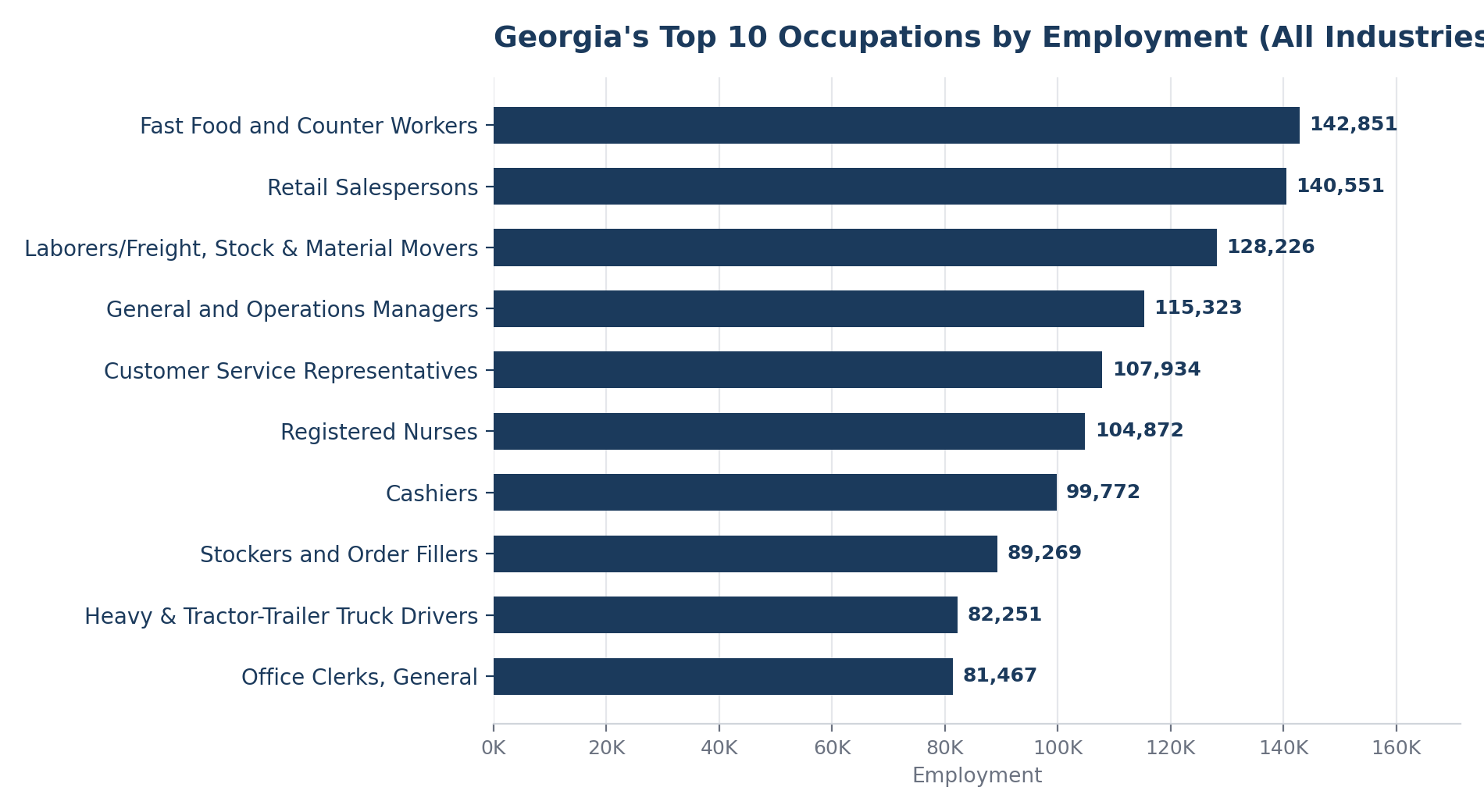
Six of the top ten occupations require no bachelor's degree — reinforcing skills-based hiring as Georgia's default.
Georgia's Top 10 Industries by Employment (3-Digit NAICS)
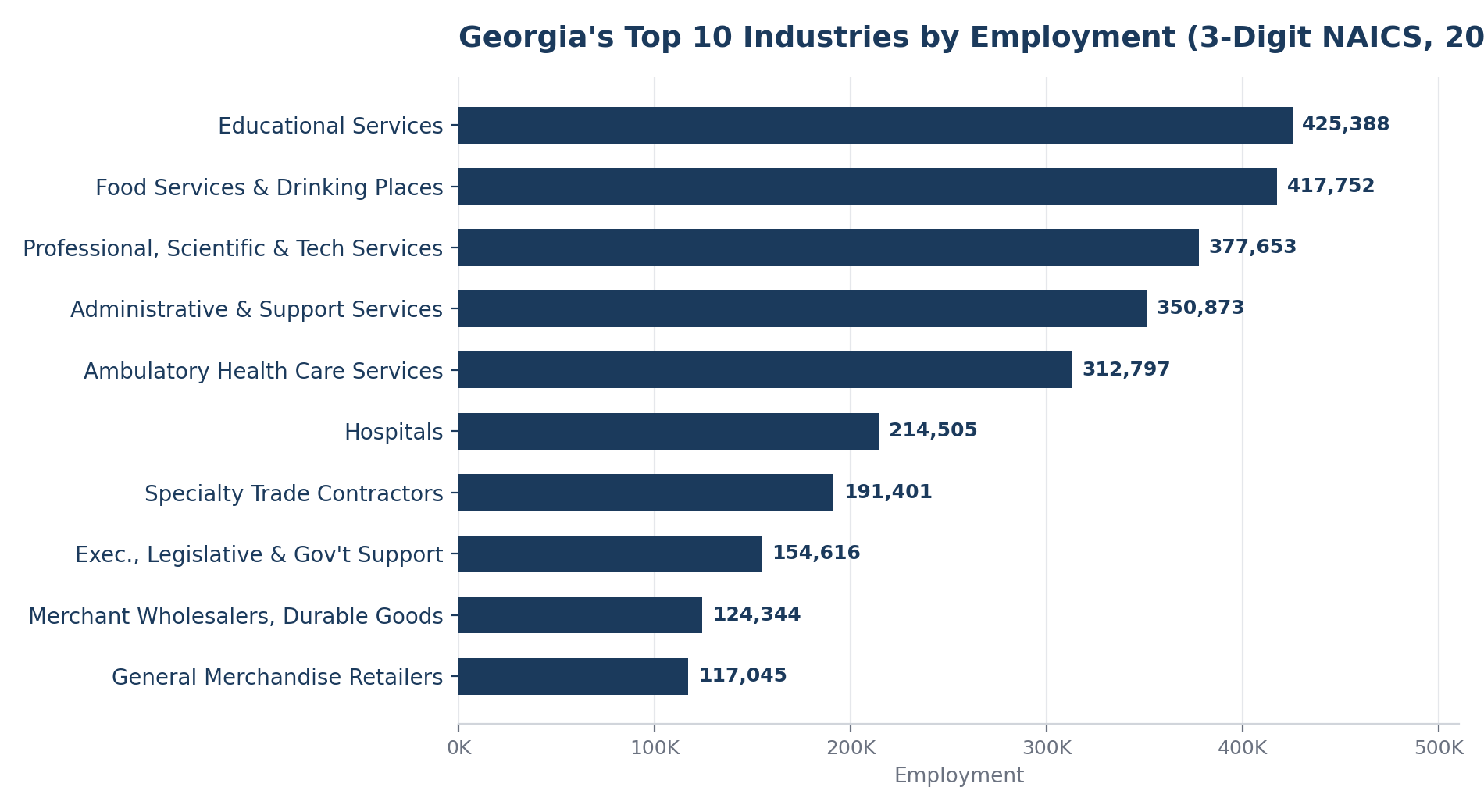
Educational Services (425,388) narrowly leads Food Services & Drinking Places (417,752), with Professional, Scientific & Tech Services (377,653) and Administrative & Support Services (350,873) rounding out the top four. Healthcare — Ambulatory Health Care Services (312,797) plus Hospitals (214,505) — collectively employs more than 527,000 Georgians.
Drivers of Georgia's Employment Growth, 2015–2025 (+773,080 jobs)
Georgia added 773,080 jobs over the last decade. A shift-share decomposition attributes 58% (448,386 jobs) to national growth and 38% (293,770 jobs) to local competitiveness — meaning Georgia is meaningfully outperforming the country. Industry mix contributed just 4% (30,923 jobs).
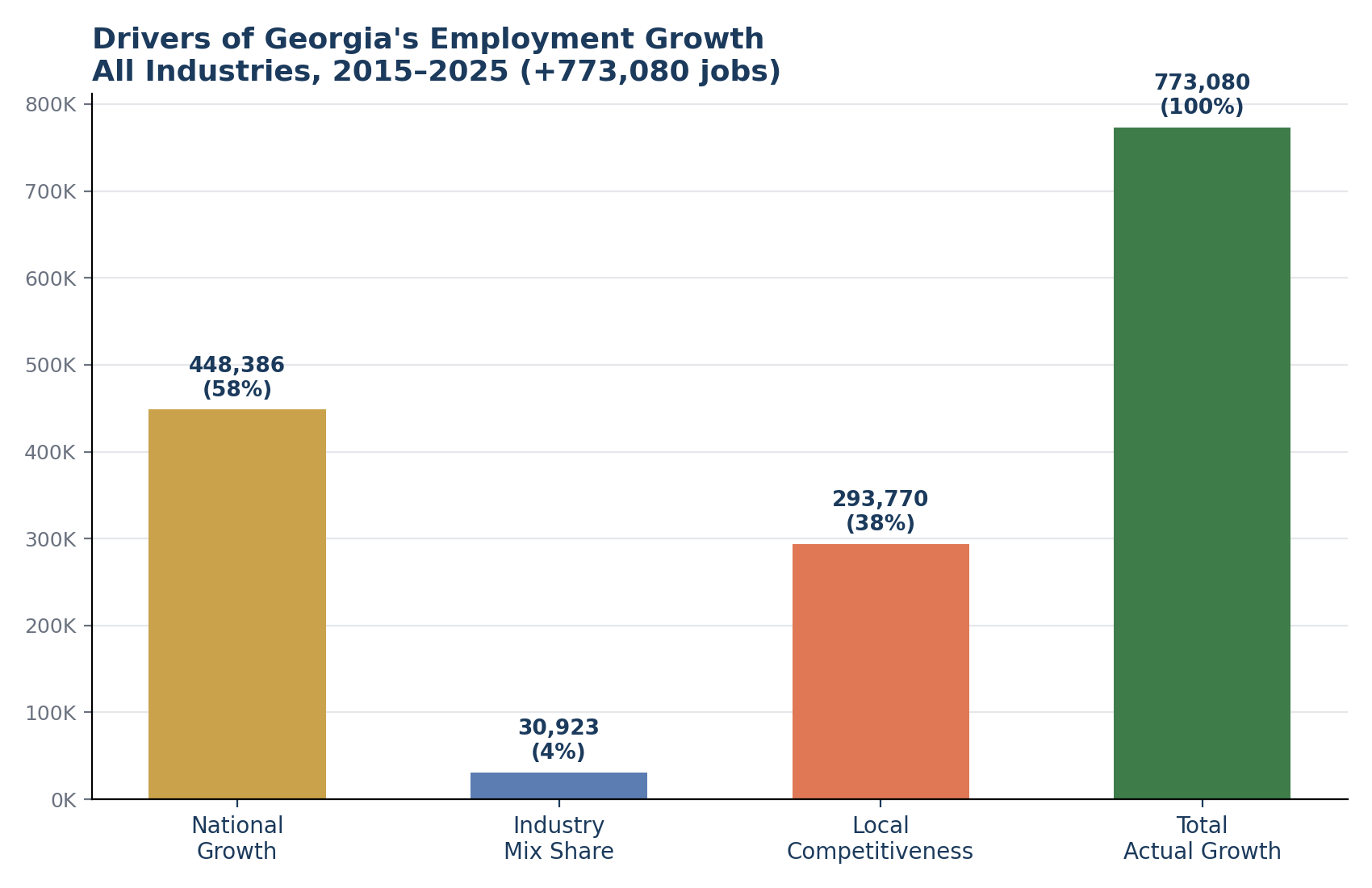
Local competitiveness — not sector composition — is Georgia's structural growth advantage.
Georgia Employment by Ownership Type (All Industries)
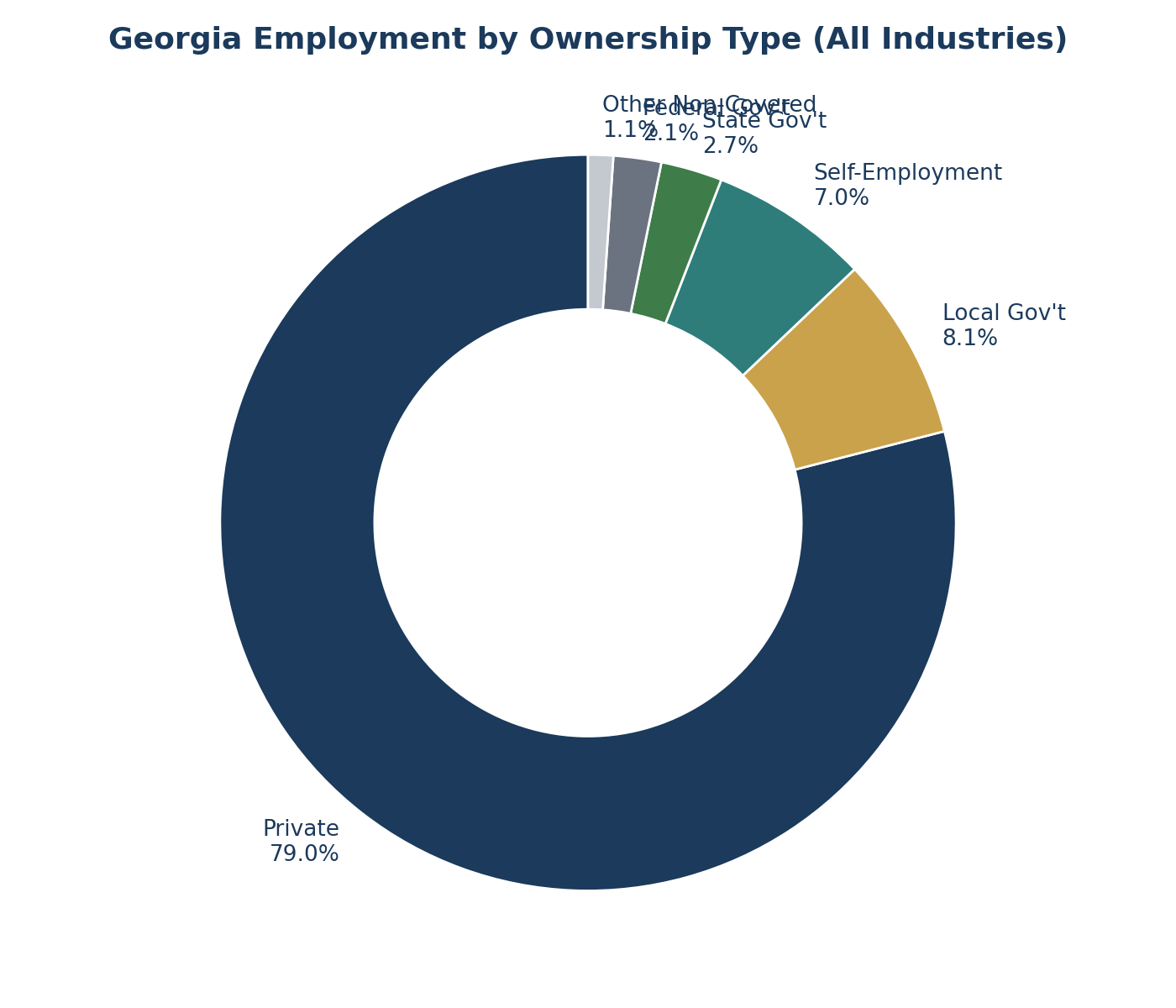
The private sector accounts for 79.0% of Georgia employment, followed by Local Government (8.1%) and Self-Employment (7.0%). State Government (2.7%) and Federal Government (2.1%) round out the public share. Georgia's workforce is overwhelmingly private-employer-driven, with local government as the second-largest employer of record.
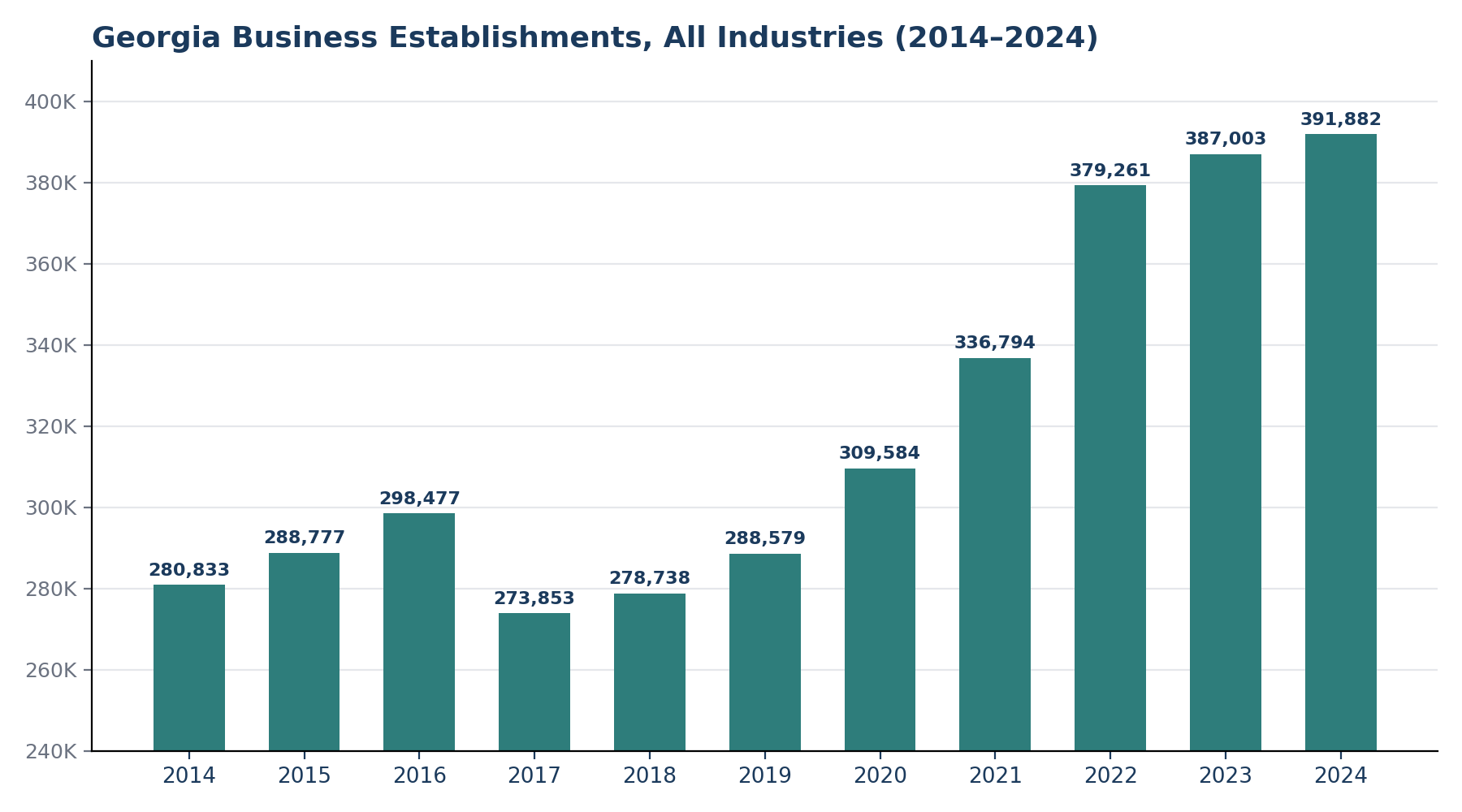
Georgia Business Establishments, All Industries (2014–2024)
Georgia's establishment base expanded from 280,833 in 2014 to 391,882 in 2024 — a 39.5% decade-over-decade increase. The step-change occurred between 2020 and 2022 (+70,000 establishments), reflecting the pandemic-era surge in new business formation that Georgia has largely retained through 2024.
Top Postsecondary Programs Linked to Georgia's Workforce Demand
Georgia Tech's Computer & Information Sciences program (4,259 awards) dwarfs every other completion pipeline in the state. Behind it, five of the next nine programs are in nursing (Registered Nursing and Nursing Assistant/Aide) across Emory, Chamberlain, Georgia Southern, and the Technical College System of Georgia — directly aligned with the state's #6 in-demand occupation.
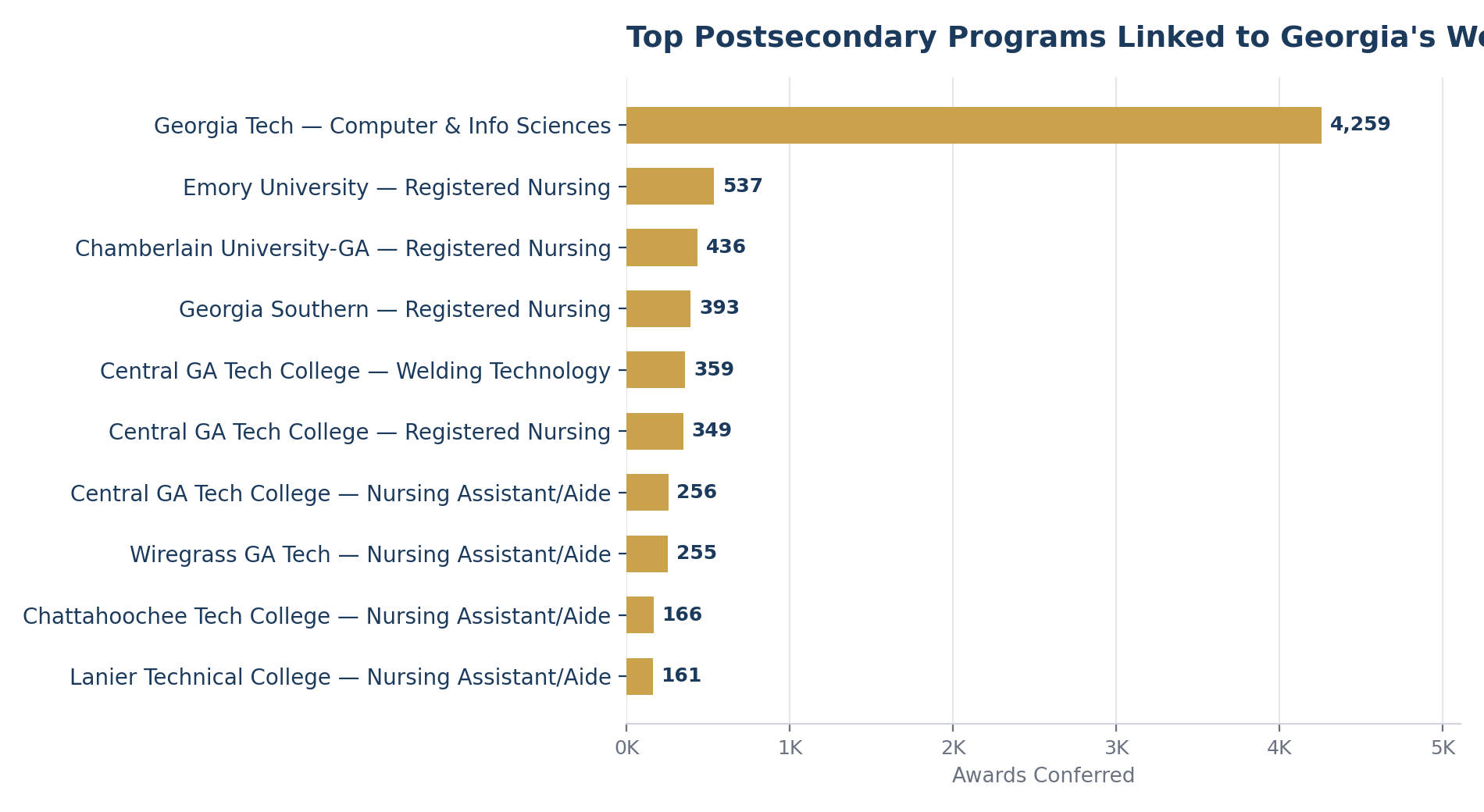
Nursing and computing account for the vast majority of Georgia's demand-aligned postsecondary output.
Data sources: JobsEQ® (Chmura Economics & Analytics) — Georgia occupation, industry, ownership, establishment, and shift-share tables (2025Q4). Postsecondary completions from IPEDS via JobsEQ program alignment. Prepared by PPV Georgia.